IAFF Mobile
- 4.2
- Rating
- 10.00K
- Installs
- Free
- Price

 Analysis by App-foxy
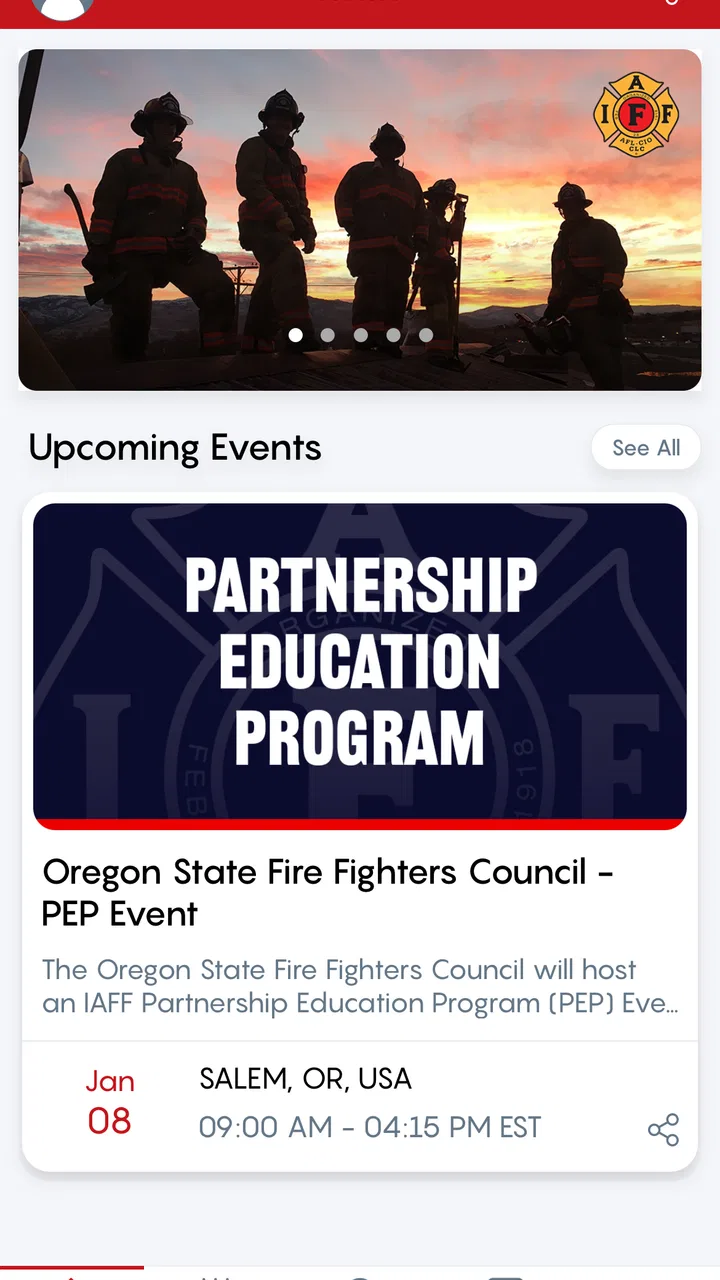
I approached IAFF Mobile as a practical companion for people connected with the International Association of Fire Fighters, rather than as a general-purpose events app. That distinction matters. Its developer is the International Association of Fire Fighters, its store summary identifies the app with that organization, and the short description is simply “IAFF Mobile.” In everyday use, that makes the app feel aimed at a defined community instead of someone casually browsing public events.
The app is free, carries an Everyone age rating, and belongs to the Events category. It has reached over ten thousand installs, with an average rating of 4.2 from roughly fifty ratings. Those figures suggest a modest but real audience and a generally favorable reception, although they do not make this a universally useful download. I would judge it mainly by whether you need an IAFF-focused mobile access point, not by comparing it with huge event platforms designed for every kind of conference or local activity.
What I found useful when assessing IAFF Mobile
When I assess IAFF Mobile, I look beyond whether it can put organization-related information on a phone: I consider how well a focused app fits into a person’s existing routines and where a browser or calendar remains the better tool. That practical distinction helps me decide when a dedicated app earns a spot on my home screen. Next, I turn to the choices and habits that make using it feel more deliberate.
You May Also Like

 Blood Strike: 2.5 Anniversary
Blood Strike’s Loadouts Turn Every Drop Into a Tactical Gamble
A close look at Blood Strike’s custom loadouts: how fast access to signature weapons reshapes its battle royale rhythm, rewards preparation, and narrows the gap between fights.

 Pandora - Music & Podcasts
Pandora’s Music Is Easy to Start, but Harder to Recover
Pandora’s strength is its low-effort path from a seed to a station. Its weak spot is how much confidence it asks you to place in connection, setup, and quiet recovery.

 8 Ball Pool
 Is Built on Rivalries, Rematches, and Routine
A close look at the rivalries, rematches, shared routines, and unanswered safety questions that turn a quick pool match into a persistent mobile community.

 Samsung Music
’s Quiet Strength Is Playing What You Already Own
Its reach comes less from spectacle than from dependable access to a personal library. That simplicity is both the app’s strongest retention engine and its ceiling.

 AccuWeather: Weather Radar
AccuWeather Review: A Quick, Clear Forecast for Everyday Decisions
For everyday plans, the best forecast is the one you can understand quickly. AccuWeather makes rain timing, radar, and local conditions easy to act on, with a few trade-offs.

 Hill Climb Racing
Why Hill Climb Racing Still Turns Crashes Into One More Run
A tiny car, a bumpy hill and one more upgrade: Hill Climb Racing keeps resurfacing because its simple chaos makes every near-miss feel personal.
More From Our News Desk



A focused tool for an organization-specific audience
The clearest strength is its focus. If I were attending an IAFF-related event, preparing for an association activity, or trying to keep relevant information close at hand, I would prefer an app built around that organization over a generic calendar filled with unrelated listings. A narrow purpose can reduce the effort involved in finding the information that actually matters to you.
That focus also defines the app’s limits. I would not install it expecting a broad city-events guide, a general conference marketplace, or a replacement for the calendar and communication tools I already use for personal appointments. Its value depends on your relationship with the IAFF and on whether the organization’s mobile content matches what you need at the moment.
One useful habit is to decide what job you want the app to perform before relying on it. If you need organization-specific event access, it may deserve a place on your phone. If you only want occasional public entertainment recommendations, a mainstream events service will probably be a better fit. This simple distinction prevents the common mistake of judging a specialized app against a completely different category.
Trust starts with knowing who stands behind it
For me, the developer identity is an important part of the trust picture. IAFF Mobile is associated with the International Association of Fire Fighters itself, rather than presenting an unclear third-party identity. That does not automatically answer every privacy or security question, but it gives the app a recognizable institutional context and makes it easier to understand why the app exists.
I also appreciate that the app’s public positioning is restrained. The store summary does not make extravagant promises about replacing every other tool or solving every event problem. A concise description can be frustrating when you want a complete feature tour, but it also means I am less likely to mistake promotional language for a guarantee.
My advice is to treat the developer identity as one part of a sensible check, not as a substitute for reading the app’s visible choices on your own device. Before using it for an important event, I would open the app, review what it asks me to do, and confirm that the information shown is relevant to my role. That is especially sensible when an app is designed for a specific membership or professional community.
What I would check before entering sensitive information
Event apps can become more sensitive than they first appear. Even when the basic purpose is scheduling or information access, users may encounter sign-in screens, registration details, contact information, or event-related records. I would therefore pause whenever IAFF Mobile asks for anything beyond what is necessary to view the content I came to see.
The right question is not simply “Is this app from a known organization?” I would ask what information is being requested, why it is needed at that moment, and whether the screen gives me a clear choice. If I only want to browse event information, I would avoid volunteering profile details unless the app clearly explains their purpose. If registration is required for a particular activity, I would enter only accurate information that is genuinely needed.
This is also where the app’s specialized nature creates a trade-off. A focused organizational tool may be more useful when it knows which event or audience you belong to, but that can involve more personal context than a generic public calendar. I would be comfortable with that only when the request is understandable and proportionate to the task.
Permissions deserve a deliberate look
I would review the permission prompts rather than accepting them automatically. The important detail is not the number of prompts but whether each one makes sense for the action I am taking. For example, an event app might reasonably need a capability for a feature I actively choose, while an unrelated request would deserve more scrutiny. I would grant access only after seeing a clear connection between the permission and the function on screen.
Android also lets me revisit permissions later, which gives me a useful safety net. If I allowed something during setup and later decided I did not need it, I would check the system settings and adjust it. That approach is more practical than assuming the first choice is permanent, and it keeps control with me as my use of the app changes.
I would apply the same caution to notifications. Event reminders can be valuable when I am attending something time-sensitive, but constant alerts can become noise. My preference would be to enable notifications when they help me prepare or stay on schedule, then reduce or disable them after the event if they no longer serve a purpose. That is a small setting, but it has a noticeable effect on how intrusive an app feels.
A realistic day-to-day scenario
Imagine that I am preparing for an IAFF-related gathering and want one place on my phone for the relevant event information. I would install the app ahead of time, open it on a stable connection, and look through the available content while I still have time to correct a login issue or clarify an unfamiliar screen. I would save or note anything I need for travel and check notification choices before the day becomes busy.
On the event day, I would use the app as a quick reference rather than as my only source of critical information. I would keep essential details, contact information, or travel instructions available in another form if they were important. That is not a criticism unique to this app; phones lose signal, batteries run down, and event information can change. A specialized app is most helpful when it reduces friction without becoming a single point of failure.
Afterward, I would review whether I still needed the app installed. If I attend IAFF activities regularly, keeping it available may be worthwhile. If I only used it for one occasion, uninstalling it or reducing its notifications could be the cleaner choice. This workflow respects both convenience and privacy without assuming that every app should remain permanently active.
Where user control matters most
I look for visible choices: whether I can decide when to sign in, whether notifications can be managed, whether permissions can be changed through the operating system, and whether the app lets me leave without making that process confusing. These controls are more meaningful to me than a polished interface because they determine how much influence I retain after installation.
I would also pay attention to account behavior. If the app offers an account-based area, I would use a strong, unique password and avoid sharing credentials with anyone else. If I no longer needed the account, I would look for an in-app route or an official support route to manage it. I would not assume that deleting the app automatically removes an account or any information associated with it; those are separate actions and should be treated separately.
When using a shared or borrowed device, I would be especially careful. I would sign out if the app supports that option, avoid saving credentials in a place other people can access, and check that private event information is not visible in notification previews. These are ordinary precautions, but they are particularly useful for an app tied to an organization and its community.
How it compares with familiar alternatives
The usual alternative is a web browser. A browser is more flexible and often better for searching across several sources, but it can require more tapping and may not keep an organization-specific experience as close at hand. IAFF Mobile makes more sense when I want a dedicated entry point and expect to return to IAFF-related content.
A second alternative is a general calendar app. That is better for combining personal appointments, work commitments, travel plans, and reminders in one timeline. I would use a calendar to protect the time around an event, but I would not expect it to provide the same organization-focused context as a dedicated app. In practice, the two can complement each other: the specialized app for event information, the calendar for my own schedule.
General event platforms are stronger when I am comparing many unrelated conferences, local activities, or ticketed experiences. They may offer broader discovery, but that breadth can make a specific IAFF activity harder to find. Choosing between them depends on whether discovery or relevance is the priority. For an IAFF-connected user, relevance is likely the more important quality.
Email and official web pages remain useful backups because they are easy to access from different devices. I would not dismiss them, especially when an event is important. My preferred setup would be to use IAFF Mobile for convenience while keeping the most important practical details somewhere I can reach if the app is unavailable.
Compatibility and maintenance considerations
The published requirements make the app accessible to devices running Android 7.0 or later. That covers many older Android phones, which is helpful if you do not replace your device frequently. At the same time, older hardware can affect loading speed, battery behavior, and how comfortably an app runs alongside other services. I would test it before an important event rather than waiting until the last minute.
The current version is 18.6.12, while the app was released on January 11, 2017. I mention those details because they provide useful context: this is an established app with a long presence, but an older release history also means I would keep it updated and pay attention to how it behaves on my particular phone. I would install updates through the official app marketplace and restart the app after a major change if something looked unusual.
Storage is another small practical issue. I would not keep an app solely out of habit if I had stopped using it, especially on a phone with limited space. Conversely, if I know an event is approaching, I would install and test it early enough to discover compatibility or account problems while support and alternatives are still available.
Who will get the most from it
I see the strongest fit for IAFF members, participants, attendees, and people who regularly need information connected with the International Association of Fire Fighters. The app’s focused identity should make more sense to them than to someone with no connection to the organization. It may also suit users who prefer a dedicated mobile destination instead of repeatedly searching through a browser.
I would be more cautious about recommending it to someone who wants a complete personal planning system. It is not the app I would choose for managing family appointments, unrelated professional meetings, broad event discovery, or a complex travel itinerary. Those needs call for tools designed around calendars, maps, messaging, or general event search.
I would also suggest that occasional users install it only when they have a clear reason. Free access lowers the barrier, and the Everyone rating makes it broadly approachable, but convenience is not the same as necessity. If your only requirement is one piece of information that is already available elsewhere, the browser may be simpler.
My cautious verdict
IAFF Mobile earns my recommendation as a specialized Events app for people who genuinely need an IAFF-centered mobile experience. Its strongest qualities are its clear organizational connection, focused purpose, free access, and relatively approachable device requirement. The rating of 4.2 from around fifty ratings is encouraging, while the audience size of over ten thousand installs suggests it has found users beyond a tiny test group.
My recommendation comes with boundaries. I would not treat it as a universal event manager, and I would not enter personal information or approve permissions without understanding the reason for each request. I would manage notifications, keep an alternative source for essential details, and review account and device settings periodically. Those steps let me benefit from the app without handing over more control than the task requires.
My bottom line is simple: install it when IAFF-specific access is the problem you are trying to solve. For that audience, a dedicated app can be more convenient than a browser or a general event platform. For everyone else, the narrow focus is likely to outweigh the benefit. I would use it as a focused companion, keep my choices deliberate, and judge its ongoing value by whether it genuinely makes IAFF-related event information easier to reach.
FAQs for IAFF Mobile
01What is IAFF Mobile and what does it offer?
IAFF Mobile is an app designed for members of the International Association of Fire Fighters. It provides access to vital resources, including updates on union activities, training materials, and health and safety information. The app also offers a platform for members to connect, share experiences, and stay informed about industry news.
02Is IAFF Mobile available on both Android and iOS devices?
Yes, IAFF Mobile is available for download on both Android and iOS platforms. Users can find it on the Google Play Store and the Apple App Store, ensuring that members can access the app's features regardless of their device preference.
03Does IAFF Mobile require a membership to access its features?
Yes, IAFF Mobile is primarily designed for IAFF members, so a valid membership is required to access the full range of features. This ensures that the resources and community interactions are exclusive to those within the organization, enhancing member engagement and support.
04How often is the content within IAFF Mobile updated?
The content in IAFF Mobile is updated regularly to ensure members have access to the latest information. This includes updates on union activities, new training materials, and important industry news. Regular updates help keep members informed and engaged with the latest developments in their field.
05Is there a cost associated with downloading or using IAFF Mobile?
IAFF Mobile is free to download for all IAFF members. However, since it is a member-exclusive app, accessing its features requires an active membership. There are no additional costs associated with using the app once membership is verified.
Pros
- User-friendly interface with intuitive navigation.
- Provides real-time updates and notifications.
- Includes a comprehensive database of resources.
- Customizable alerts for personalized experience.
- Secure login with multiple authentication options.
Cons
- Limited offline functionality reduces accessibility.
- Occasional slow loading times affect usability.
- Some features require in-app purchases.
- Notifications can be overwhelming if not managed.
- Limited language support may affect non-English users.

IAFF Mobile
Gallery